Disclaimer: These are merely my own thoughts concerning my transition. I do not wish to invalidate anyone with different experiences!
I understand and accept wholeheartedly that I am biologically male. I know this with unusual certainty because I was conceived via in vitro fertilization (IVF). Before I was implanted into my mother’s womb, genetic testing identified my sex chromosomes as XY. In an irony that has never quite escaped me, the second most viable embryo was XX. I know that every cell in my body contains a Y chromosome.
Despite this, I also live as a woman.
At first glance, these statements may appear mutually exclusive. The contemporary debate surrounding transgender people involves two competing narratives: either biology determines one’s gender completely, or one’s internal sense of identity transcends biology. My own experience has never fit comfortably into either framework. I have never denied my biology, but neither have I found it capable of explaining the entirety of my experience. Biology explains the body I inhabit, but not the social life I have gradually brought into existence.
Unlike many transgender people, I have never experienced my transition as the discovery of an innate female essence hidden beneath my male body. There was never a moment in which I uncovered my “true self.” There were never “signs.” My transition began because at sixteen, I wanted to wear makeup. I wanted to experiment with feminine clothing. In private, I enjoyed presenting myself in ways that my culture associated with women.
These desires did not reveal some metaphysical truth about who I secretly was. They became the starting point of a process through which I gradually became someone different.
Existentialism gives me a vocabulary for understanding this process. Rather than asking what a person essentially is, philosophers like Jean-Paul Sartre began by asking how a person comes to be who they are. Human beings are born into conditions they do not choose (a concept Sartre calls facticity). Our bodies, birthplaces, histories, families, and genetics are facts about ourselves. Unfortunately for me, they are not chosen, nor can they simply be wished away.
When I was in first grade, I was diagnosed with growth hormone deficiency and received growth hormone injections for most of my childhood (~8 years). The treatment accelerated my puberty, and many of the secondary sexual characteristics that still make me feel uncomfortable developed unusually early. My voice deepened before I understood why this change disturbed me. I remember hiding my obscenely hairy legs in the boy’s locker room. When I was around 13, I was even offered champagne at a wedding! These developments belong to my facticity. They happened to me long before I realized they could be responded to rather than merely endured. Five years later, I fully accepted Sartre’s radical freedom (the idea that humans are obligated to make authentic, decisive choices) and began to take my life into my own hands.
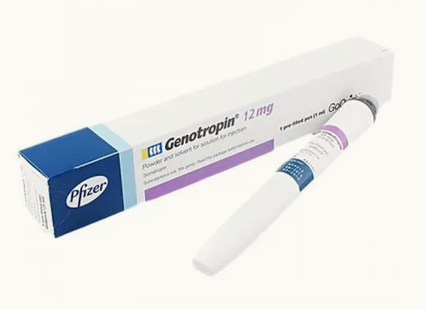
A 12mg Genotropin autoinjector pen. I must have received over 2,000 nightly injections with different brands of synthetic human growth hormone.
Dysphoria, then, is not discomfort with biology itself. Rather, it is the experience of living through a body whose unchosen characteristics shape both my own experiences and the ways in which others encounter and interact with me.
Yet, my transition was never really an attempt to escape these facts. Instead, it emerged from my inherent freedom to respond to them. Sartre argues that consciousness is never simply a thing among other things. It is always directed toward possibilities beyond what already exists. Human beings are defined not only by what they are, but by what they project themselves toward becoming. Looking back, I do not see my first experiments with crossdressing as evidence that i had secretly been a woman all along. Now, I see them as the beginning of an existential project. Through repeated choices, how I dressed, how I presented myself, the medications I took, and even how I understood myself, I gradually created an identity that had not existed before.
Accepting my biological facticity does not mean accepting that my biology completely determines my existence. Sartre distinguishes the objective facts from consciousness itself, which he calls being-for-itself. Unlike a rock or a tree, humans are never merely what they are. We continuously project ourselves toward possibilities that do not yet exist.
At sixteen, I closed my bedroom door and tried on feminine clothing for the first time. Later, I experimented with nail polish, learned how to apply eyeliner, and eventually presented myself like this in public. None of these choices felt like uncovering some “true” identity that I had all along. Rather, each action expanded the range of possibilities available to me.
It would be easy to reinterpret these memories through hindsight and use them to prove that I had always been a woman. However, doing so would flatten the complexity of my own experience. My transition feels less like discovering something hidden in me than gradually constructing a new way of existing.
However, my freedom alone cannot explain my gender. Sartre argues that we also exist for others (i.e., we become objects within another person’s consciousness). This insight explains something I experience almost daily. When an Uber driver greets my friends and me with “Hey ladies,” I occupy the social role of a woman within that interaction. In his mind, he recognizes me as a woman and treats me accordingly.
When a TSA agent tells me “sir, show me your hands,” I occupy a different social role. Nothing biological changes between these two examples, but the social reality I inhabit does. Thus, in my opinion, gender is not an internal feeling but something continuously created and negotiated through interactions with other people.
These facts also explain my dysphoria. My secondary sexual characteristics matter not simply because i personally dislike them, but because they shape how strangers conceptualize me before either of us has spoken a word. A deeper voice, more pronounced jawline, or facial hair becomes socially meaningful because they influence whether I am recognized as “sir” or “ma’am.” I accept my biology and have no wish to escape it. I don’t seek a different history, but a different way of inhabiting the body I have.
Rather than seeing this as a contradiction, I have come to understand it dialectically. Dialectical thinking allows seemingly opposing truths to coexist without collapsing one into the other; I am biologically male, yet I increasingly inhabit the social role of a woman. Upon further examination, these claims do not compete because they describe different dimensions of my existence. My body shapes how others perceive me, while my choices and presentation reshape how that same body is interpreted.
Simone de Beauvoir, Sartre’s partner, famously wrote that “one is not born, but rather becomes, a woman.” I have come to understand my own transition in a similar way. I did not discover a hidden female soul waiting to be liberated. I became a woman through a vast accumulation of choices and relationships.
My chromosomes remain part of my facticity. My freedom lies in how I respond them. My gender is created through the ongoing interplay between the body I was born in, the future I project for myself, and the gaze of the Other. If existentialism teaches us that existence precedes essence, then perhaps gender (at least in my own life) is not an essence waiting to be discovered, but a way of existing that I have gradually brought into being.
Leave a Reply